Cash Flow Under Pressure: How to Survive When Your Customers Have Less Money and Everything Costs More
Key Takeaways
-
Your customers are struggling too. Their disposable income is shrinking. Your pricing and offerings must adapt to this new reality, not fight it.
-
Your costs have permanently shifted. Electricity, fuel, and supplies are not going back to “normal.” Your breakeven point has moved, and you need to know exactly where it is.
-
Getting paid faster is now a survival tactic. Late payments hurt more than ever. You need systems to protect your cash flow before the invoice is sent.
-
Inventory is either an asset or a trap. Holding too much kills cash flow; holding too little kills sales. The “just-in-case” model is the new standard.
-
A small cash buffer changes everything. Even R5,000 set aside can prevent a crisis. Build it slowly, but build it.
You feel it every day.
Your regular customers are buying less. The ones who used to order weekly now order every other week. The ones who paid cash now ask if you take payment plans. The ones who never questioned your prices now hesitate before saying yes.
Meanwhile, your costs keep climbing. Electricity. Fuel. Ingredients. Rent. Everything.
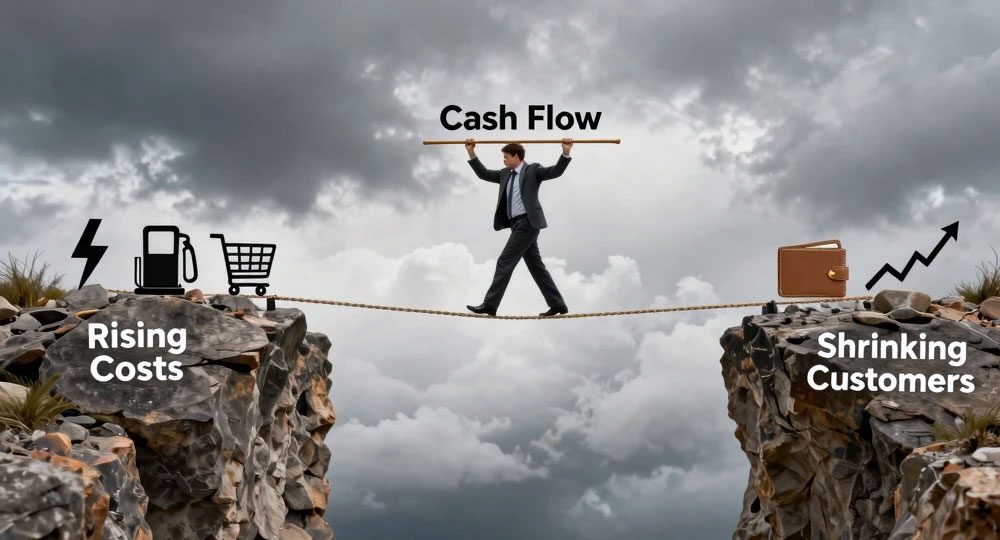
You’re caught in the middle: costs rising on one side, customers with less money on the other. And you’re the one holding it all together.
This article is not theory. It’s a practical survival guide for the business owner who is feeling the squeeze right now. Seven strategies. Real steps. Things you can do this week.
Let’s get started.
Quick Wins: Three Things You Can Do This Week
Before we dive into the strategies, here are three actions that cost nothing but can improve your cash flow immediately:
| Action | Why It Works |
|---|---|
| Call your three biggest suppliers and ask for extended payment terms (30→45 or 60 days) | The worst they can say is no. The best case gives you breathing room. |
| Review your last month’s bank statements and cancel any subscriptions or software you’re not using | Small monthly costs add up to real money over a year. |
| Send one polite payment reminder to every client with an invoice over 30 days due | Many clients pay the oldest invoices first when reminded. |
Do these today. Then work through the strategies below.
Strategy 1: Know Your Numbers (Really Know Them)
When costs were stable and customers were spending freely, you could afford to fly by instinct. Those days are over.
You need to know, with precision:
-
Your new breakeven point. Not what it was six months ago. What it is today. How much must you sell each week just to keep the doors open?
-
Your cost per unit, including hidden costs. Have you factored in generator fuel during load shedding? Extra transport costs? Price increases from suppliers that you haven’t passed on?
-
Which products or services actually make money. Some jobs keep you busy but don’t pay. Others are your real profit drivers. Know the difference.
The action: Block out two hours this week. Spreadsheet open. Bank statements out. Work through your numbers line by line. If you’re not a numbers person, pay someone to do it. This is not optional.
Strategy 2: Price with Confidence (Even When It’s Scary)
The biggest mistake business owners make in tough times is freezing prices because they feel guilty asking customers to pay more.
But if you don’t raise prices, you die. It’s that simple.
How to do it right:
-
Small, regular increases are less painful than one big jump. A 5% increase now and another in six months is easier to absorb than 10% overnight.
-
Communicate honestly. Tell your customers: “Our costs have gone up significantly. We’ve held off as long as we could, but we need to adjust our prices to keep serving you.” Most people understand because they’re feeling it too.
-
Bundle or tier your offerings. Keep an entry-level option affordable for price-sensitive customers. Create a premium option with more value for those who can still pay. Let the customer self-select.
The action: Identify one price increase you can implement this month. Start small. Communicate clearly. Watch what happens—you’ll likely lose fewer customers than you fear.
Strategy 3: Get Paid Faster (Because Late Payments Hurt More Now)
Late payments are always frustrating. When your margins are squeezed, they can be fatal.
You need systems to protect your cash flow before the invoice is sent.
Practical tactics:
-
Deposits for new clients. For larger jobs, ask for 50% upfront. This covers your costs and filters out clients who weren’t serious.
-
Progress payments for longer projects. Invoice at milestones, not just at the end. This keeps cash flowing while you work.
-
Discounts for early payment. Even 2% off for payment within 7 days can incentivize clients to pay quickly.
-
Late payment interest—and actually charge it. Include it in your terms, mention it on invoices, and apply it consistently.
-
Invoice factoring as a last resort. Yes, it costs money. But if a large invoice is 90 days late and you need cash now, it may be worth the fee.
The action: Review your payment terms today. Are they clear? Are they on every invoice? If you don’t have a late payment policy, create one this week.
Strategy 4: Rethink Your Inventory (Just-in-Case vs. Just-in-Time)
For years, “just-in-time” inventory was the gold standard: hold as little stock as possible, order only what you need, keep cash free.
That model breaks when supply chains are unpredictable. Port delays, load shedding, supplier price hikes—all of it means you can’t rely on stock arriving exactly when you need it.
The new approach: just-in-case.
-
Identify critical stock—the items you cannot run out of without losing sales. Hold a buffer of 10-15%, even if it ties up cash.
-
Negotiate longer payment terms with suppliers. If they want you to hold more stock, they should help you finance it. Ask for 60 or 90 days.
-
Cut slow-moving stock. If something hasn’t sold in months, it’s not inventory—it’s clutter. Sell it at cost or below just to free up cash and space.
-
Consider dropshipping or pre-orders for expensive or slow-moving items. Let the customer finance the purchase.
The action: Walk through your stock this week. Identify your top 10 critical items. Do you have a buffer? If not, start building one.
Strategy 5: Cut Costs That Don’t Cut Value
Across-the-board cuts often hurt more than they help. Cutting marketing when you need customers most is a classic mistake.
Instead, cut strategically:
-
Electricity. The Energy Bounce Back Scheme can help you finance solar. Yes, it’s a capital outlay. Yes, it pays back over time. If you’re in a location where load shedding hurts your business, this is worth exploring.
-
Subscriptions. Auditing your bank statements often reveals software, memberships, or services you forgot about. Cancel what you’re not using.
-
Marketing. Stop spraying and praying. Identify which channels actually bring in paying customers and focus there. Cut the rest.
-
Rent. If your lease is up for renewal, negotiate. Landlords would rather keep a tenant at slightly lower rent than find a new one.
-
Staff. Before retrenchments, consider reduced hours or a temporary salary sacrifice. Be honest with your team. Many would rather work less for less than lose their job entirely.
The action: This month, audit one category of expenses (subscriptions, marketing, or utilities). Find at least one cut you can make.
Strategy 6: Create Offers for Cash-Strapped Customers
Your customers have less money. That doesn’t mean they don’t want what you offer. It means they need a way to buy that fits their smaller budget.
Meet them where they are:
-
Smaller packages. Can you offer a half-size version of your product or service at a lower price point?
-
Payment plans. Not casual “pay whenever” arrangements—structured plans with clear terms. Get it in writing.
-
Loyalty programmes. Reward frequency, not just spend. A free coffee after five purchases keeps people coming back.
-
Bundles. Combine popular items at a slightly discounted price. It feels like value to the customer and moves more product for you.
The action: This week, create one “budget-friendly” offer. Test it with your existing customers. See what happens.
Strategy 7: Build a Cash Buffer (Even Small)
Every cash flow crisis eventually comes down to one question: Do you have money in the bank when you need it?
A cash buffer is your safety net. It’s the difference between surviving a slow month and closing your doors.
How to build it:
-
Automate it. Set up a standing order that moves a percentage of every payment into a separate savings account. Even 5% adds up.
-
Start small. R5,000 set aside prevents a crisis. R10,000 gives you breathing room. R20,000 is a real buffer.
-
Keep it separate. Don’t use this account for daily expenses. Out of sight, out of mind.
-
Replenish it. If you have to use it, make rebuilding it your first priority.
The action: Open a separate savings account this week. Set up an automatic transfer of 5% from every payment you receive. Start today, even if it’s a small amount.
Quick Reference: The 7 Strategies
| Strategy | Core Question | First Step |
|---|---|---|
| 1. Know Your Numbers | What’s my new breakeven? | Block two hours this week for a financial review |
| 2. Price with Confidence | How do I raise prices without losing customers? | Identify one price increase to implement this month |
| 3. Get Paid Faster | How do I stop late payments from killing me? | Review and strengthen your payment terms |
| 4. Rethink Inventory | Am I holding too much or too little stock? | Identify critical items and build a 10% buffer |
| 5. Cut Costs Strategically | Where can I save without hurting value? | Audit one expense category this month |
| 6. Create Budget-Friendly Offers | How do I serve customers with less money? | Create one smaller package or payment plan |
| 7. Build a Cash Buffer | How do I prepare for the next crisis? | Open a separate savings account and automate 5% |
The Path Forward
You’re under pressure. Your customers have less money. Your costs keep rising.
That’s the reality. Denying it won’t help. Panicking won’t help.
What helps is action. Small, deliberate, consistent steps to strengthen your position.
Pick one strategy from this list. Just one. Do it this week.
Then pick another. And another.
You don’t have to do everything at once. You just have to start.
The businesses that survive this season won’t be the ones with the most capital or the luckiest breaks. They’ll be the ones that adapted—that looked reality in the face and made the changes needed to keep going.
That can be you.
Start today.
Disclaimer:
This article is for general informational and educational purposes only and does not constitute financial, legal, or professional advice. You should consult with a qualified professional for advice tailored to your specific circumstances.
References
- South African Government. (2025). Energy Bounce Back Loan Guarantee Scheme. [online] Available at: https://www.gov.za/EBB (Accessed March 2026).
- Stellenbosch Business School. (2026). SME Insights 2026: Access to Finance. [online] Available at: https://www.usb.ac.za/research (Accessed March 2026).
- Lula. (2026). Business Funding for South African SMEs. [online] Available at: https://www.lula.co.za (Accessed March 2026).
- FNB. (2026). Community Economy Report: Small Business Insights. [online] Available at: https://www.fnb.co.za/business (Accessed March 2026).
- Sunday Times. (2026). 2026 will reward those SMEs that prepared. [online] Available at: https://www.sundaytimes.timeslive.co.za/business (Accessed March 2026).
- Department of Small Business Development. (2026). Asset Assist Programme Guidelines. [online] Available at: https://www.dsbd.gov.za (Accessed March 2026).