
I work 70-hour weeks but my business doesn’t grow. What am I doing wrong?
You pour every ounce of your energy into your business. The sun hasn’t risen, but you’re already answering emails. Long after your neighbours have settled in for their evening, your desk lamp is still burning. You tally the hours, seventy of them, maybe more, and a quiet dread sets in. Despite the sacrifice, the sleepless nights, and the relentless hustle, the needle on your business’s growth just won’t budge. Your bank balance looks eerily similar to last year’s, and that mountain of work never seems to get smaller.
If this is your reality, you are not alone. This is a silent scream echoing across the small business landscape, from tech hubs to main streets and home offices. The dream of being your own boss has collided with the brutal reality of stagnation, and the question burns: “I work 70-hour weeks but my business doesn’t grow. What am I doing wrong?”
The painful, liberating truth is this: you are likely doing nothing wrong, but you are likely doing the wrong things. You have fallen into the 70-Hour Week Trap, where activity is confused with productivity, and busyness masquerades as business strategy.
You’re Working In the Business, Not On It
This is the cardinal sin of the overwhelmed business owner. When you are buried in seventy-hour weeks, you are almost certainly stuck in the operational weeds. You are the head chef, the chief waiter, and the dishwasher. You are the lead developer, the customer service agent, and the accounts clerk. You are doing the work, but you are not directing the work.
Think of your business as a ship. You’re down in the engine room, shovelling coal with immense effort, ensuring the engines keep chugging. But who is on the bridge, steering the ship, plotting the course, and avoiding icebergs? If you’re always below deck, you’re just powering a vessel that’s going in circles, or heading straight for a reef.
The distinction between working in your business and on your business was popularised by Michael Gerber. He argues that an entrepreneur must wear three hats: the Technician (who does the technical work), the Manager (who manages the systems), and the Entrepreneur (who innovates and visions the future). Right now, you’re probably only wearing the Technician’s hat, and it’s stained with sweat and exhaustion.
The Local Context: Unique Challenges Feeding the Trap
Our environment as small business owners adds layers of complexity that can force us into reactive, fire-fighting modes. These external pressures make it even harder to climb out of the operational grind and think strategically.
-
Infrastructure and Economic Volatility: Fluctuating costs, interest rate hikes, and market uncertainty make forecasting a nightmare. This can push you into a short-term survival mindset, where you’re focused on making payroll this month rather than building a marketing plan for the next year. You’re patching holes in a leaking boat instead of sailing it to a new, prosperous harbour.
-
The Pressure of Being a Provider: As a business owner, you often carry the weight of not just your own family’s livelihood, but that of your employees. This immense pressure can lead to risk-aversion, making you hesitant to invest in a new marketing campaign or a crucial piece of equipment, even when it’s the key to growth. You stick to the “safe” grind, even when the grind itself is unsafe for your long-term health and business viability.
The High Cost of Hustle: What You’re Sacrificing
Believing that more hours equals more success is a dangerous fallacy. The law of diminishing returns is very real. After a certain point, the quality of your work plummets, and the cost to you and your business skyrockets.
-
Your creativity and strategic thinking are the first casualties of exhaustion. You can’t innovate when you’re running on empty.
-
Your physical and mental health deteriorates, leading to burnout – a state of emotional, physical, and mental exhaustion that can take months or years to recover from.
-
Your personal relationships suffer, creating a lonely, stressful existence that makes the entrepreneurial journey unsustainable.
-
You make poor decisions driven by fatigue and desperation, which can often do more damage to your business than inactivity.
The Pivot: From Overworked Operator to Strategic CEO
Escaping the trap requires a fundamental mindset and operational shift. It’s about moving from being the business’s chief labourer to its chief architect. This isn’t about working less; it’s about working smarter, with intense focus on leverage.
Ruthlessly Prioritise and Delegate
Your most valuable asset is not time, but attention. You must identify the activities that only you can do – the high-impact tasks that drive growth, like strategy, key client relationships, and vision-casting. Everything else is a candidate for systemisation or delegation.
Start by conducting a simple time audit for one week. Write down everything you do. You will likely find that a significant portion of your time is spent on low-value, administrative tasks that someone else could handle. Could a virtual assistant manage your diary and emails? Could a part-time bookkeeper free you from invoicing? Delegating isn’t a luxury for large corporations; it’s a survival tactic for the solo entrepreneur. It’s an investment that buys you the time to do the work that actually grows the revenue pie.
Systemise Everything You Can
A system is simply a way of doing something that works, written down so that it doesn’t depend on one person’s memory. What are the repetitive tasks in your business? From onboarding a new client to producing your product, every repeatable process should be documented.
This does two things. First, it makes delegation possible and efficient. You can hand over a process, not just a chaotic set of instructions. Second, it builds an asset. A business that runs on systems is a business that can eventually run without you being involved in every single detail. This is the foundation of scalability.
Focus on Revenue-Generating Activities (RGAs)
This is the heart of the shift. You must become merciless about how you spend your strategic hours. Ask yourself this question about every task on your to-do list: “Is this directly contributing to generating revenue for my business?”
-
Updating your website’s FAQ page? Not an RGA.
-
Networking with a potential big client? That’s an RGA.
-
Manually formatting a report? Not an RGA.
-
Crafting a pitch for a new market? That’s an RGA.
This doesn’t mean non-RGAs aren’t important. It means they are not the best use of your focused, strategic time if you are the growth engine of the business.
Measure What Matters
Many struggling business owners are flying blind. They look at their bank balance at the end of the month and hope it’s positive. This is not a strategy. You need to identify your Key Performance Indicators (KPIs). These are the numbers that truly reflect the health and trajectory of your business.
For most small businesses, this isn’t a complex dashboard. It could be:
-
Number of new qualified leads per week.
-
Customer acquisition cost.
-
Average value of a sale.
-
Customer lifetime value.
By focusing on a handful of these metrics, you shift from a vague feeling of “things aren’t growing” to a precise understanding of why. “We are not growing because our number of new leads has dropped by 30% since last quarter.” This specific problem is one you can solve. A vague feeling of stagnation is not.
Your Time is Finite, Your Strategy Shouldn’t Be
The narrative of the entrepreneur as a superhuman hustler, thriving on no sleep and constant pressure, is a dangerous myth. It’s a myth that is keeping countless business owners stuck, exhausted, and unfulfilled.
Your worth as an entrepreneur is not measured by the hours you log; it is measured by the value you create and the impact you make. The 70-hour week is not a badge of honour; it is often a red flag, a signal that the business owns you, not the other way around.
The path forward isn’t about doubling down. It’s about stepping back. It’s about having the courage to stop shovelling coal for a few hours, to climb up to the bridge, and to finally take hold of the wheel. Chart a new course, one defined not by relentless activity, but by deliberate, strategic direction. The future of your business doesn’t demand more of your time. It demands more of your mind.
Your Two Paths to “The Freedom Blueprint”
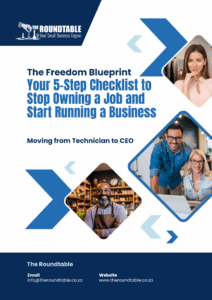 If you’re ready to stop being the chief everything officer and start acting as the CEO, I have created a practical, step-by-step guide: The Freedom Blueprint.
To make this accessible to every dedicated business owner, I’m offering two ways to get it.
Path 1: Instant Access (R97)
Ideal if you’re ready to start immediately and value convenience.
- One-click instant download.
- Get started on your freedom plan in the next 2 minutes.
- Your purchase supports the creation of more free, in-depth articles like this one.
Click Here to Buy. Instant Access.
Path 2: The No-Cost, Manual Option (Available until Christmas 2025)
I believe so strongly in this system that I don’t want cost to be a barrier.
If the R97 is a genuine obstacle right now, simply email me at info@theroundtable.co.za with the subject “Freedom Blueprint” and I will email it to you for free. This free offer is available until midnight on Christmas day, 25/12/2025. I will send the guide to everyone who emails within a few weeks after the Christmas deadline.
Choose the path that’s right for you right now. The important thing is to start moving from being busy to building a business that works for you.
References:
- Gerber, Michael E. The E-Myth Revisited: Why Most Small Businesses Don’t Work and What to Do About It. HarperBusiness, 1995.
- Grant, Adam. Think Again: The Power of Knowing What You Don’t Know. Viking, 2021.
- Stats SA. Quarterly Labour Force Survey (QLFS) – Q1:2024. Statistics South Africa, 2024.
Disclaimer: This article is for educational and informational purposes only and does not constitute professional business, financial, or legal advice. You should consult with a qualified professional for advice tailored to your specific situation before making any business decisions.